Google I/O 26 Wasn’t About AI Demos. It Was About AI Taking Over Everything.
Google I/O 2026 marked the beginning of Google’s agentic Gemini era, where AI is no longer just a chatbot, but the invisible layer powering Search, Android, Gmail, coding tools, shopping, and smart glasses.
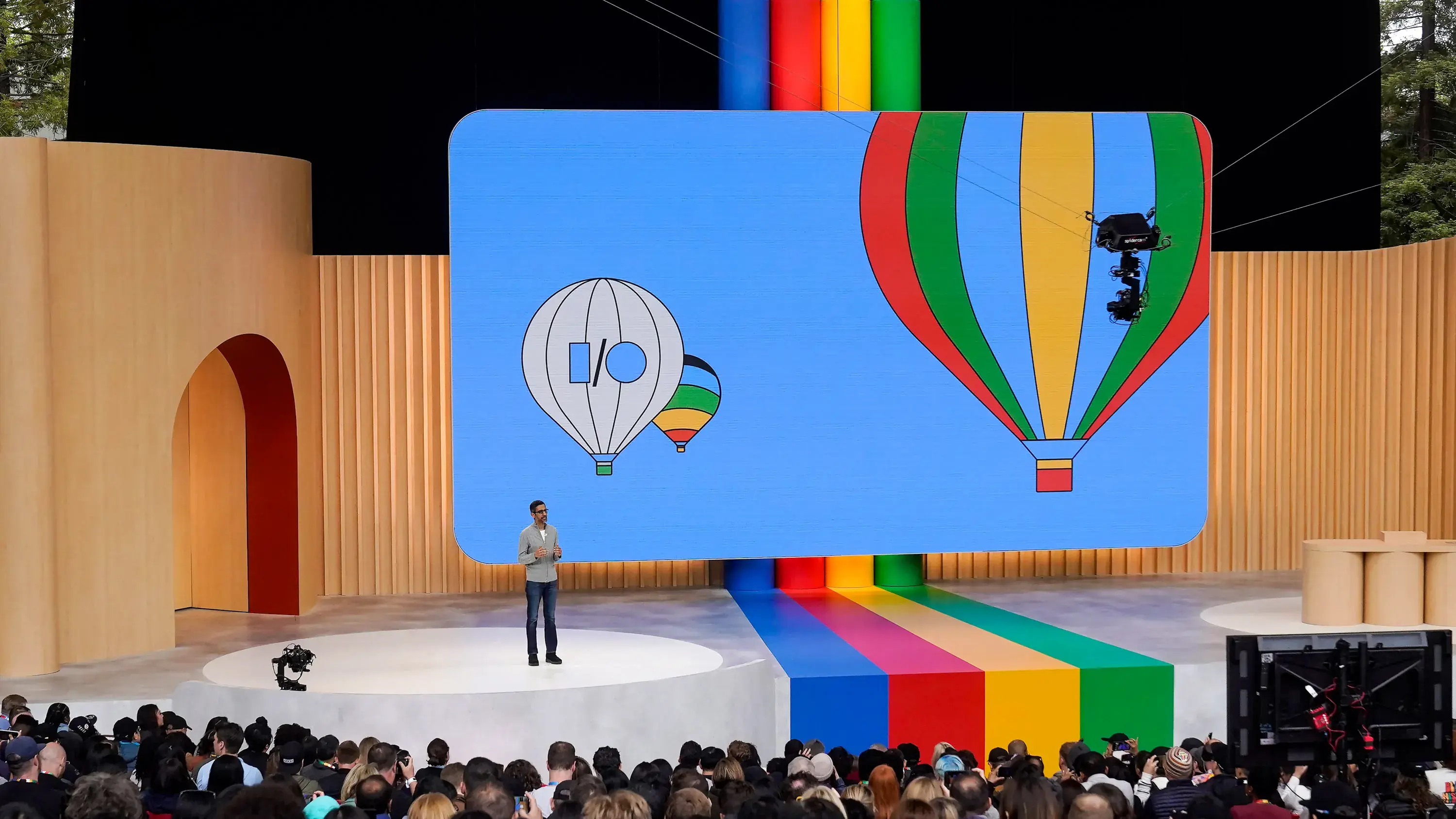
Google I/O 2026 made one thing painfully obvious: Google no longer sees AI as a separate product. It sees AI as the layer that will sit underneath almost everything — Search, Gmail, Android, shopping, creative tools, coding platforms, smart glasses, and maybe even the way we interact with the internet itself.

This year’s event was not just another keynote full of flashy demos. It felt like Google drawing a line in the sand. The old Google organized the world’s information through blue links. The new Google wants Gemini to become the interface between you and reality.
That is why almost everything at I/O came with the word Gemini attached to it. Gemini Spark. Gemini Omni. Gemini Flow. Gemini Flash. Gemini inside Search. Gemini inside Gmail. Gemini inside Android. Gemini inside glasses. Google is calling this the agentic Gemini era, and the message is clear: the future of software is not apps you open, but agents that act for you.
The most important announcement was Gemini Omni, Google’s new multimodal model built to take almost any input — text, video, sound, or images — and produce almost any kind of output. This matters because models like this are no longer just generating pretty images or videos. They are moving closer to understanding language, motion, physics, and context well enough to simulate parts of the real world on demand.
Alongside Gemini Omni, Google also introduced a new design language for the Gemini app called Neural Expressive. On the surface, it looks like a visual refresh with cleaner icons, smoother gradients, and a more polished interface. But the bigger idea is more interesting: the interface itself can become generative. Instead of only showing static screens, Gemini can create diagrams, timelines, mini apps, and interactive UI elements based on what the user asks.
Google also announced Gemini 3.5 Flash, its new fast model. This is not meant to be the biggest “brain” in the Gemini family, but it is designed to be fast, capable, and useful for real-time tasks. According to the keynote framing, it sits in a strong position for speed and intelligence, although Gemini 3.5 Pro is still being held back for a later release. That disappointed some people, but it also shows Google is trying to separate its model lineup more clearly: Flash for speed, Pro for heavier reasoning.
Of course, none of this matters without scale, and scale is where Google still has one of its biggest advantages. The company is now serving an almost absurd amount of AI tokens every month, growing from trillions to quadrillions of tokens in just a couple of years. That kind of growth explains why Alphabet’s infrastructure spending has exploded. AI is not cheap, and Google is building the hardware, data centers, and chips needed to keep the machine running.


A major part of that machine is Google’s TPU, or Tensor Processing Unit. This year, Google announced a more specialized direction for TPUs, separating training and inference workloads with TPU-T and TPU-I. In simple terms, one chip is optimized for training models, while the other is optimized for running them at massive scale. That distinction matters because AI is no longer a research experiment. It is now a global infrastructure problem.
For developers, one of the most interesting announcements was the new direction of Google Antigravity. Previously known as Windserve, Antigravity is now being pushed as an agent-first coding environment. Instead of simply helping developers write code line by line, it is designed around managing AI agents that can plan, build, test, and coordinate software tasks.
The live demo made that vision feel real. Google showed Antigravity helping build an operating system from scratch, then fixing missing drivers live so Doom could run on it. It was partly ridiculous, partly impressive, and very on-brand for modern AI demos. But the point was clear: the future of coding tools may not be about autocomplete anymore. It may be about supervising agents that build software on your behalf.
Still, not everyone is going to like that shift. Traditional programmers may see tools like Antigravity as another step away from hands-on engineering and toward AI-managed development. But Google is betting that speed will win. If an AI coding environment can produce working systems faster than a human team can scaffold them manually, the industry will eventually follow.

Google Search also continued its transformation into an AI agent. The company is no longer treating Search as a list of links. Instead, Search is becoming something that can summarize, reason, compare, shop, plan, and eventually complete tasks. For users, that could make Google more useful. For publishers, it is much more worrying. If Search answers more directly, fewer people may click through to websites.
Shopping is moving in the same direction with Universal Cart, Google’s AI-powered shopping layer across Search, Gemini, YouTube, and Gmail. The idea is not just to help users find products, but to manage the buying process itself — deals, carts, prices, stock, and recommendations. It is another example of Google turning a messy internet behavior into a centralized AI workflow.
But I/O 2026 was not only about AI models and agents. One genuinely interesting developer announcement came from Chrome: the HTML on Canvas API. This allows developers to render native HTML elements inside a canvas, opening the door for highly interactive interfaces that combine pixel-level control through technologies like WebGL and WebGPU with the practicality of regular HTML UI elements.
That may sound small compared to Gemini Omni or AI agents, but for web developers, it is a big deal. Canvas has always been powerful, but building accessible and interactive UI inside it has been difficult. Native HTML support inside canvas could make advanced browser-based tools, games, dashboards, and creative apps easier to build.


Google also returned to one of its oldest futuristic ideas: smart glasses. This time, the pitch feels more practical. Android XR-powered glasses, built with partners like Gentle Monster and Warby Parker, are expected to begin as audio-first glasses. With Gemini inside, they could answer questions, send messages, translate speech, help with navigation, capture photos and videos, and connect to apps without requiring users to constantly pull out a phone.
That is the real theme of Google I/O 2026: ambient AI. Google does not want Gemini to be something you open in a tab. It wants Gemini to follow you across devices, apps, screens, cameras, browsers, inboxes, and wearables.
There are still big questions. Will these agents actually work reliably? How much will they cost? How much personal data will they need? What happens to websites when Search becomes more answer-focused? And will users trust Google enough to let Gemini act across Gmail, shopping, Android, and smart glasses?
But even with those questions, Google I/O 2026 felt like a turning point. Google is no longer simply trying to prove that it can compete with OpenAI, Anthropic, or anyone else in AI. It is trying to show that it has the ecosystem, infrastructure, chips, models, apps, and distribution to make AI unavoidable.

The old Google helped people find information.
The new Google wants Gemini to do the finding, thinking, building, buying, coding, watching, and answering for them.
That is exciting. It is also a little terrifying.
And that is exactly why Google I/O 2026 mattered.